A set of non-invasive, radiation-free pregnancy screenings from conception to delivery.
An ultrasound (or sonogram) for pregnancy screening is a multi-type, non-invasive, safe diagnostic tool for monitoring fetal development and maternal health.
There are various types of ultrasound examinations performed during pregnancy depending on fetal growth stage: transvaginal ultrasound (weeks 6-10), transabdominal ultrasound (after week 10), morphological ultrasound (week 20), 3D/4D ultrasound, and Doppler ultrasound. Testing purposes range from confirming pregnancy and estimating the due date to timely detecting fetal abnormalities and other complications.
The ultrasound’s field of view may be limited by fetal position or other factors, such as maternal obesity, resulting in a longer examination or a re-examination.
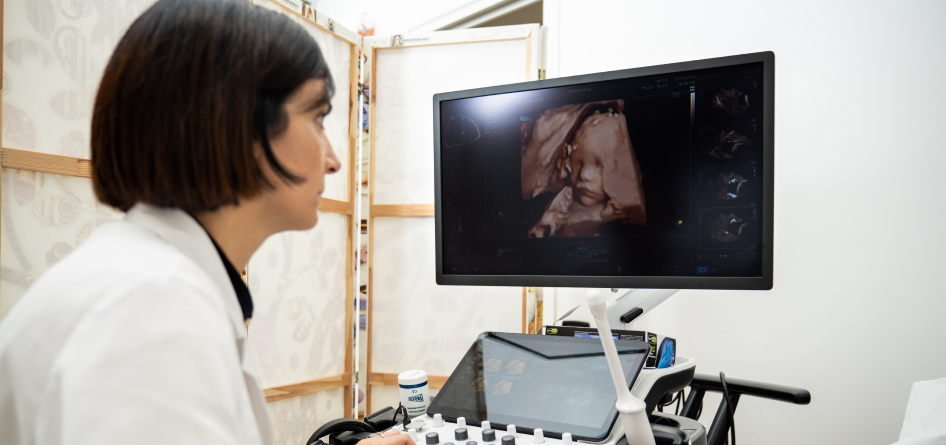
Ultrasounds are completely safe because they use sound waves rather than radiation. No specific preparation is necessary unless the sonographer states otherwise. It’s generally a mild, painless procedure that may last 20-45 minutes, depending on test type and fetal position:
The ultrasound probe is covered in special gel to improve image quality
The probe is placed on the abdomen or inserted vaginally (TVUS)
The operator moves the probe to capture images from different angles
If you have any questions before the examination, don’t hesitate to ask a specialist.
Pregnancy-related ultrasound results are provided to you immediately and sent to your OB-GYN (if a different specialist performs the test) for evaluation.
Each type of ultrasound examination has its own timing and purpose. Early on, ultrasound detects ectopic pregnancy and preterm labor risk. In the later stages, it confirms stable pregnancy development or detects any structural fetal anomalies, complex issues, growth restriction, and several other potentially critical findings.
Depending on the results, further specialized examinations may be necessary to determine the next steps, such as closer monitoring, clinical intervention, or a change in delivery planning (early delivery or Cesarean section).
For appointments, call my office every Thursday between 9.30 and 15.30.



